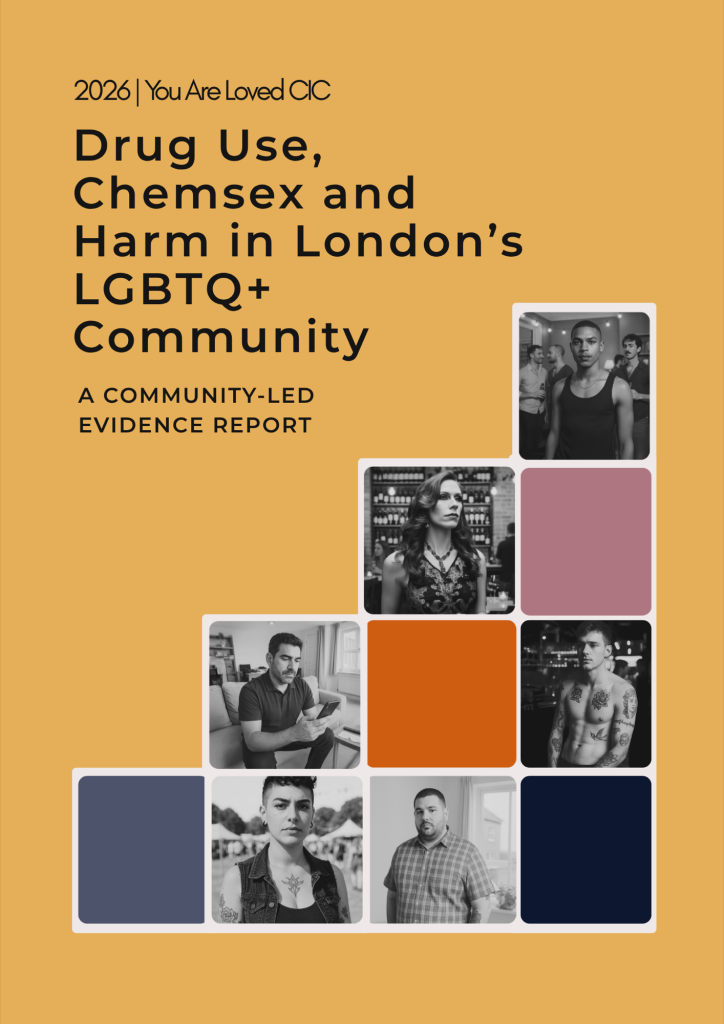

MaReport of 1,156 LGBTQ+ people also finds that a third of people using these recreational drugs reject the word “chemsex” — and that two thirds of GHB/GBL users have passed out while using it
London, [September 14th, 2026] — LGBTQ+ people who use crystal meth, GHB/GBL or mephedrone are almost three times more likely to describe their own drug use as harmful than those using other recreational drugs, according to a major new community survey published today.
Drug Use, Chemsex and Harm in London’s LGBTQ+ Community: A Community-Led Evidence Report (2026), produced by You Are Loved CIC, surveyed 1,156 LGBTQ+ people, of whom 560 reported using one or more of the three recreational drugs most associated with chemsex.
Among those using the three ‘chemsex drugs’, 46% reported some level of concern about their use — 21% describing it as slightly concerning, 13% as problematic and 12% as a big problem. Among respondents who used other drugs but none of the three, the equivalent figure was 17%. Only 19% of those using the three ‘chemsex drugs’ described their drug use as generally positive.
The pattern holds for each of the three substances taken separately, indicating that it is not driven by any single drug.
The report is published 9 months after the Office for National Statistics established, for the first time, that LGB+ people in England and Wales are 2.8 times more likely to die from drug poisoning than heterosexual people. The ONS did not publish a breakdown by substance, leaving no national data on deaths involving the three ‘chemsex drugs’ at the centre of queer drug use.

Photo by Sushil Nash
Three drugs, three different risks
The report argues that crystal meth, GHB/GBL and mephedrone are routinely discussed as a single category, and that this obscures differences with direct consequences for how services are designed.
Crystal meth carries the heaviest harm profile of the three. Only 15% of people using it described their drug use as generally positive, while almost 60% reported some level of concern, including 20% who called it a big problem. It is used overwhelmingly in sexualised settings — 71% at sex parties and 53% at chillouts — but 41%, more than two in five, reported using it at home alone. The report identifies this solitary use as a significant warning sign, indicating that for a substantial group use has moved out of social and sexual contexts into an isolated pattern consistent with problematic use.
GHB/GBL shows a similar sexualised core, with 75% reporting use at sex parties and 66% at chillouts, but extends into nightlife: around a third (34%) reported using it in clubs. Half of GHB/GBL users reported some level of concern about their drug use. The report identifies overdose as the central risk, given that the margin between an active dose and a dose causing unconsciousness is measured in millilitres and narrows further when GHB/GBL is combined with alcohol.
Mephedrone has the broadest social footprint of the three and the lowest harm profile, though 44% of people using it still reported some level of concern. Sex parties (68%) and chillouts (64%) remain common, but 69% reported using it in clubs, 35% in bars and 34% at dinners or parties with friends. The report argues that this social integration is itself a risk factor, normalising use and lowering the threshold for trying it.
“Single-message drug education that treats the three substances as interchangeable will miss all three of these dynamics,” the report concludes.
Passing out on GHB/GBL has become ordinary
Two thirds of respondents who use GHB/GBL reported having passed out or fallen asleep involuntarily while using it. The report is unambiguous that each of these episodes is an overdose.
It argues that the sheer frequency of these episodes has driven their normalisation: when an event is common it stops being treated as an emergency, friends let someone sleep it off, parties continue around an unconscious person, and the episode is reframed as an ordinary hazard rather than a medical event. In the worst cases, emergency services are not called in time.

Photo by Peter Bucks
Who calls it chemsex — and who does not
The survey also examined how people using these drugs describe what they do. Among those using at least one of the three, 33.7% said they would always call their drug use chemsex and 35.5% said they would sometimes do so. A further 30.7% — close to a third — said they would not use the term at all, despite using one or more of the three drugs.
Identification tracks closely with how intensive and how harmful the use is. Among respondents who did not consider their drug use problematic, 22% would always call it chemsex. That rises to 31% among those describing their use as slightly concerning, 47% among those calling it problematic, and 70% among those who described it as a big problem.
The number of substances used is the strongest single predictor. Among people who reject the term, 44% use only one of the three drugs, compared with 16% of those who identify with it; 36% of identifiers use all three, compared with 14% of non-identifiers. People using crystal meth were almost twice as likely to apply the label as those using mephedrone.
Harm perception moves in the same direction. 27% of non-identifiers described their drug use as generally positive, compared with 15% of identifiers, while 15% of identifiers called their use a big problem compared with 3.4% of non-identifiers.
The report concludes that “chemsex” operates as an interpretive label as much as a descriptive one — adopted as use escalates and as people come to judge it harmful, rather than applied to sexualised drug use as such.
The practical consequence is a communication gap. Outreach, campaigns and services that rely on the word will not be recognised by a substantial group of people whose behaviour falls squarely within the mainstream definition. The report recommends that services describe behaviours, contexts and concerns directly rather than relying on the label.
Stigma emerged separately as a barrier to seeking help. Respondents described fearing judgement from services, from partners and from the community itself. One wrote that asking for help was hard because the chemsex element was hard to give up, adding that they did not trust support services to understand them.

Photo by Copycat Fragrances
Bereavement, Covid and a prevention gap
More than a quarter of respondents (28%) reported losing at least one loved one to a drug-related death in the past five years. In Lambeth, Southwark and Lewisham the figure rises to one in three (33%), significantly higher than the 25% recorded across the rest of the sample.
The report also finds that the pandemic produced a lasting shift rather than a temporary one: 35% of respondents said their drug use increased during or since Covid and the lockdowns, against 11% who reported a decrease, a net increase of 24 percentage points. Among those using the three chemsex drugs the increase was higher still, at 41%. Prevention and commissioning frameworks built on pre-pandemic prevalence assumptions, the report warns, are likely to underestimate current need.
Support, meanwhile, arrives late. Among people using the three drugs, 86% of those who described their use as a big problem had sought support, compared with 22% of those who found it slightly concerning. Half of all respondents said there is not enough support available for people in the community struggling with drug use; 15% thought current provision sufficient.
Marc Svensson, founder and director of You Are Loved CIC, said:
“The people in this survey are telling us something quite simple: these drugs aren’t interchangeable, and GHB/GBL and crystal meth are hurting them most. A third of them are also telling us that chemsex isn’t a word they use about themselves. We must listen to both of those things when we design support.”
A summary of the findings relevant to Lambeth, Southwark and Lewisham forms part of the chemsex needs assessment being undertaken by the three boroughs.
The full survey report can be accessed and downloaded here: https://drive.google.com/drive/folders/1aZn0WKj-0j-BqXqK6oHWziNmLZL5mHzi